Part 2 established a living baseline and the discipline of comparing live operation against it. That comparison is necessary, but it is not sufficient. Knowing that a value has drifted toward the edge of the validated envelope is not the same as knowing why it matters, which systems it implicates, or what action it justifies.
A drift in one coolant loop is rarely just a coolant problem. This final part is about closing that gap, the step from noticing change to reasoning about it.
The Uptime paper concludes where every successful project hopes to arrive, at a facility that has been validated, documented and prepared for handover into operations. That is the right place for commissioning to end. It is also, for the facility, day one. From the first hour of live service the infrastructure keeps moving.
Equipment is replaced. Software changes. Cooling is adapted. Demand fluctuates. Procedures mature. Readiness is therefore earned continuously rather than certified once, and a facility that was fully validated yesterday can face conditions today that its last test never saw.
Engineering decisions depend on context no document holds
Operations teams make hundreds of consequential decisions over a facility's life. Can additional AI capacity be deployed in this hall without compromising cooling. Is it safe to take this unit down for maintenance now. Is redundancy still sufficient after the last change. Should this alarm be investigated immediately or is it expected given recent work.
Each of these depends on understanding the relationships between power, cooling, maintenance history, procedures, dependencies and the commissioning evidence that defined what good looks like. No single document contains that understanding. It only emerges when the evidence is connected.
The hard part is no longer collecting operational information. It is interpreting it.
From information to reasoning
A modern AI facility already produces enormous volumes of operational data. Telemetry. Alarms. Maintenance records. Commissioning evidence. Asset information. Test history. Procedures. The constraint was never the quantity of information. It is that the information sits in separate systems, in different formats, describing the same facility from different angles, and the work of relating them falls on people under time pressure.
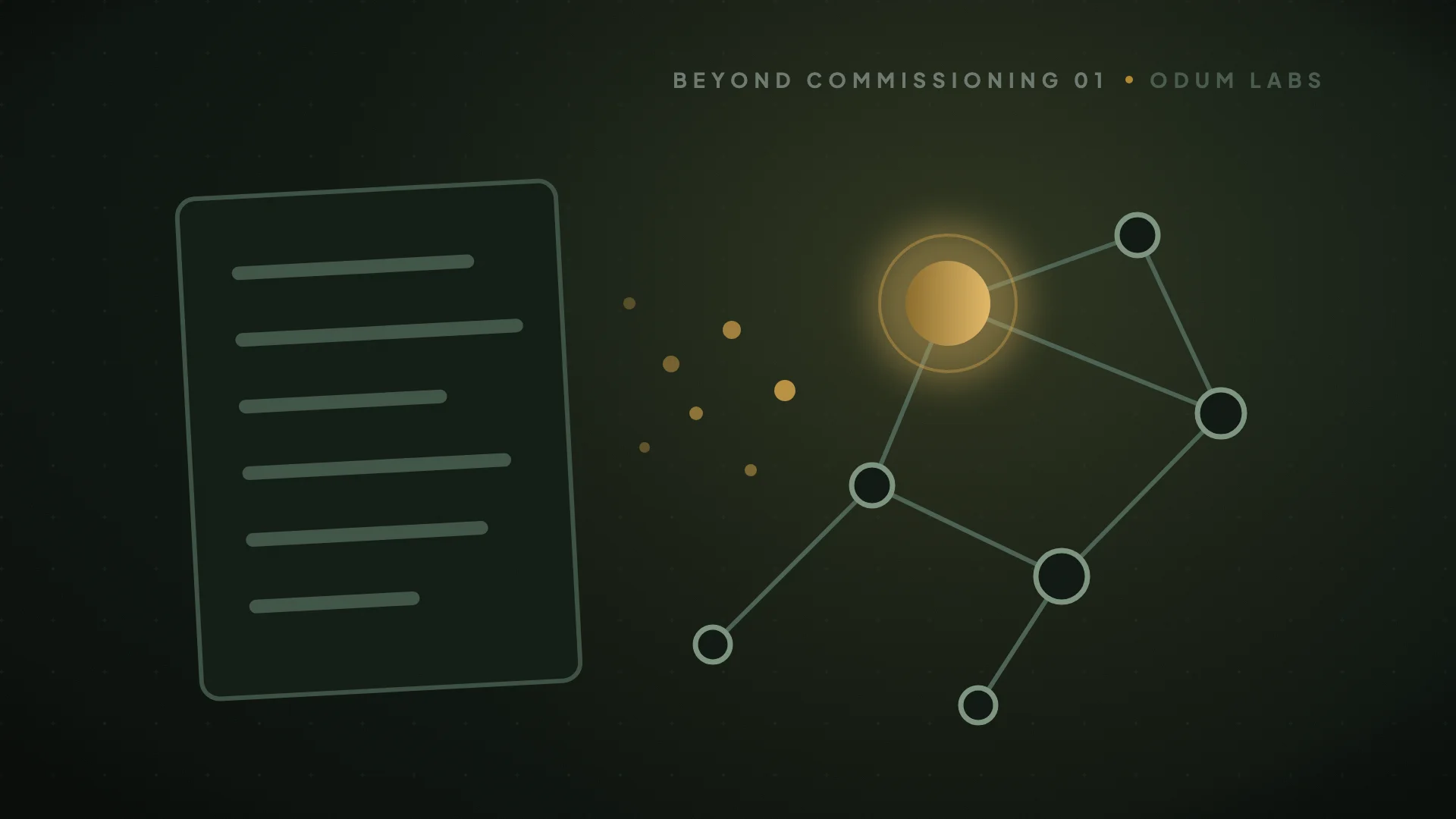
Operational reasoning is the capability that does that relating continuously. It evaluates evidence, understands how systems depend on one another, and offers decision support as the infrastructure changes. It does not replace engineering judgement. It gives that judgement a continuously updated picture of context to work from.

Fig. 1. Operational evidence feeds a reasoning layer, with commissioning evidence highlighted as the validated reference.
Building on commissioning, not beside it
This layer is only credible because of what comes before it. Commissioning establishes confidence that the facility performs correctly under defined conditions. Operational reasoning extends that confidence into daily operation. The commissioning process supplies the evidence and the validated reference. Operations supply the live context.
Held together, continuously, they form the basis for understanding readiness as it actually stands. Seen this way commissioning is not the final phase of project delivery. It is the starting point of a more intelligent operational lifecycle, and the better the commissioning evidence, the sharper the reasoning that can be built on it.
Why this is becoming unavoidable
The pressure is structural. AI facilities are larger, denser and more interconnected than the buildings the current operations toolset was designed for, and they change faster, since GPU refresh cycles run far shorter than the life of the building around them. Dashboards, document repositories and isolated monitoring tools were built to report state, not to reason about it. As complexity climbs, the cost of a misjudged decision climbs with it, in stranded capacity, in unplanned downtime against a depreciating fleet, in risk that sits outside the validated envelope and outside anyone's view.
An emerging class of operational intelligence systems is taking shape to meet exactly this, software that continuously interprets operational evidence, understands infrastructure dependencies and supports the engineers making the calls. The framework matters as much as the software. Without a shared way to structure commissioning evidence as a model that operations can reason over, every facility solves this alone, and the knowledge stays trapped where it was always trapped, in the archive.
The arc of the series
Three steps, each building on the last. Commissioning produces evidence, and that evidence should be treated as a living model rather than a closed record. The model has to stay current, compared continuously against operation as workloads change.
And the comparison only becomes useful when a reasoning layer interprets it, connects it across systems and turns it into decisions. Validation will always be essential. What the AI era adds is the requirement to keep reasoning over what validation revealed, for as long as the facility runs.
Frequently asked questions
What is operational reasoning in data center operations?
The capability that continuously relates a facility's operational evidence, telemetry, alarms, maintenance records, commissioning evidence, asset data and procedures, understands how systems depend on one another, and offers decision support as the infrastructure changes.
Does operational reasoning replace engineering judgement?
No. It gives engineering judgement a continuously updated picture of context to work from. The decisions remain with the engineers making the calls.
Why is commissioning evidence central to operational reasoning?
Commissioning supplies the validated reference that makes the rest of the operational data interpretable. The better the commissioning evidence, the sharper the reasoning that can be built on it.
Why are dashboards and monitoring tools not enough for AI facilities?
They were built to report state, not to reason about it. AI facilities are larger, denser and change faster than the buildings that toolset was designed for, and as complexity climbs, the cost of a misjudged decision climbs with it.
Uptime Institute, AI Infrastructure Advisory, Level 4 and 5 Commissioning, AI in Practice series, paper 4 of 5, 2026. uptimeinstitute.com/ai-services/ai-infrastructure-advisory
This article builds on that research. Schematic figures are original illustrations created for ODUM AI Labs and contain no measured data.