CxSTAT Vault · Document Intelligence

Drawings that answer back.

Vault reads a construction drawing set the way a senior reviewer does: identity, revision chain, tags and cross-references. Every fact it finds stays linked to the record that proves it, at data center commissioning scale.

app.cxstat.com/vault/drawing-review/sample-001
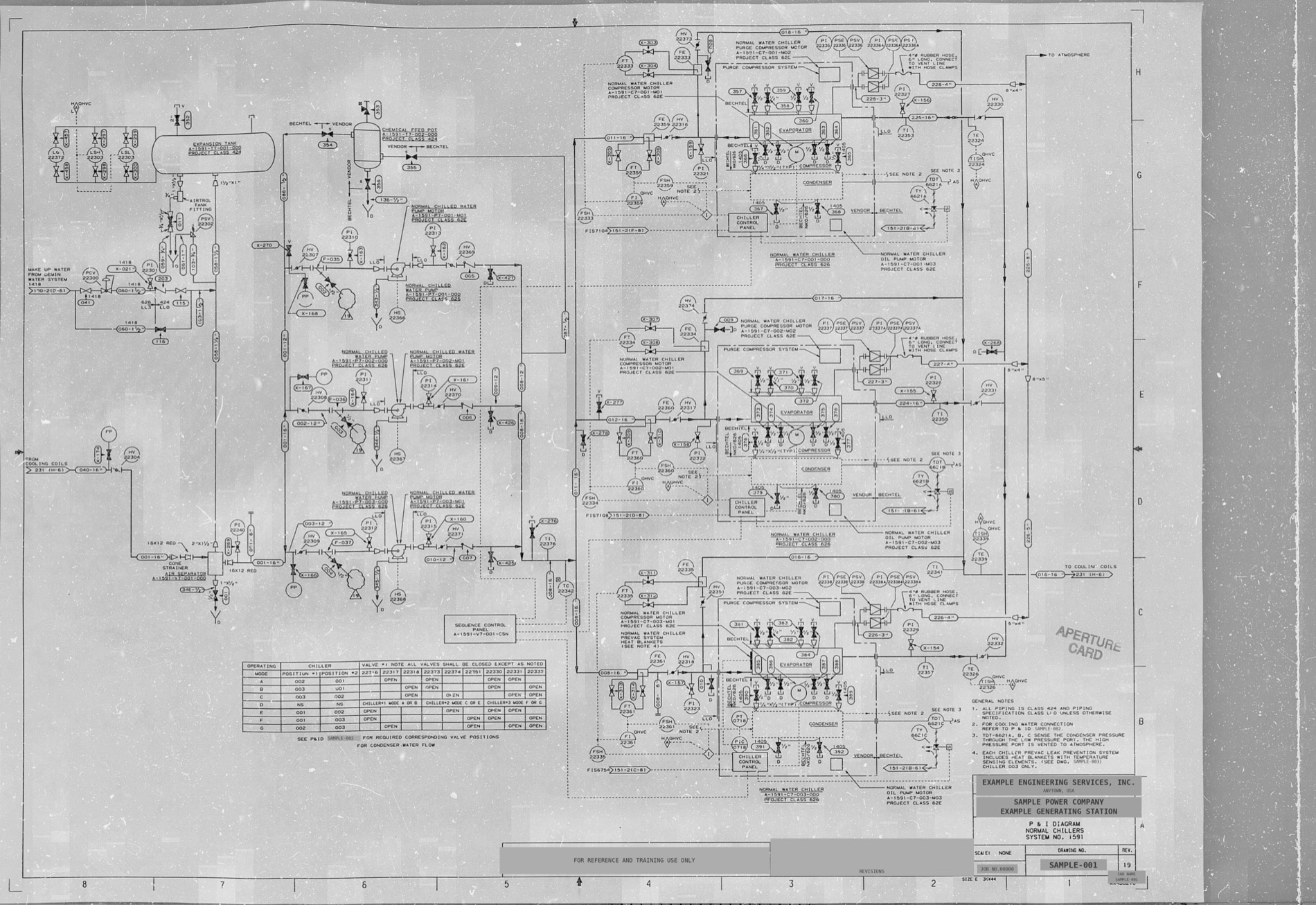
Chilled water flow diagram under Vault review
EXPANSION TANK · T7-001
CHEMICAL FEED POT
CHILLER 001 · EVAP / COND / PURGE
CHILLER 002 · EVAP / COND / PURGE
CHILLER 003 · EVAP / COND / PURGE
CHW PUMPS · P7-001/002/003
15X12 REDUCER
CONE STRAINER · AIR SEPARATOR
VALVE TABLE · MODES A TO G
SEQUENCE CONTROL PANEL
NOTE 4 · PREVAC HEAT BLANKETS
LINE 228-4 · 8 IN
GENERAL NOTES · CLASS 424
TITLE BLOCK · REV 19
Reading sheet identity…
0min → 6
per-sheet review time, manual vs Vault-guided
0
added valves reconciled from one mark-up sheet
0
documents linked to a single unit
0%
cross-references checked, not sampled
rule

Consistent review on every sheet

The same careful pass on sheet 1 and sheet 400. No fatigue, no Friday-afternoon sampling, no skipped cross-checks.

difference

Deltas caught before they cost

Added valves, superseded revisions and moved boundaries surface at review time, not during integrated systems testing.

hub

Feeds your evidence graph

Every extracted fact lands in CxSTAT IQ with lineage, powering readiness views, risk analytics and CxBrain answers.

The problem

Manual drawing review breaks down at data center scale.

A drawing review is not reading, it is reconciliation. Every sheet has to agree with the register, the mark-ups, the tag schedule and the test records around it, and the disagreements are exactly where hand-over risk lives.

history

Revisions checked from memory

Is this the current issue? Was the cloud superseded last month? The answer lives in the register, but under deadline it usually comes from memory.

alt_route

Cross-references get sampled

One mark-up added 32 valves to a manifold. Each should appear in the register, the tag schedule and a test boundary. A few get spot-checked; the rest get trusted.

draw

The trail is a margin note

Six weeks later an owner asks why a sheet was accepted. The evidence is a highlight, a pencil tick and whatever the reviewer remembers.

How Vault reads a sheet

Read. Verify. Link. Ask.

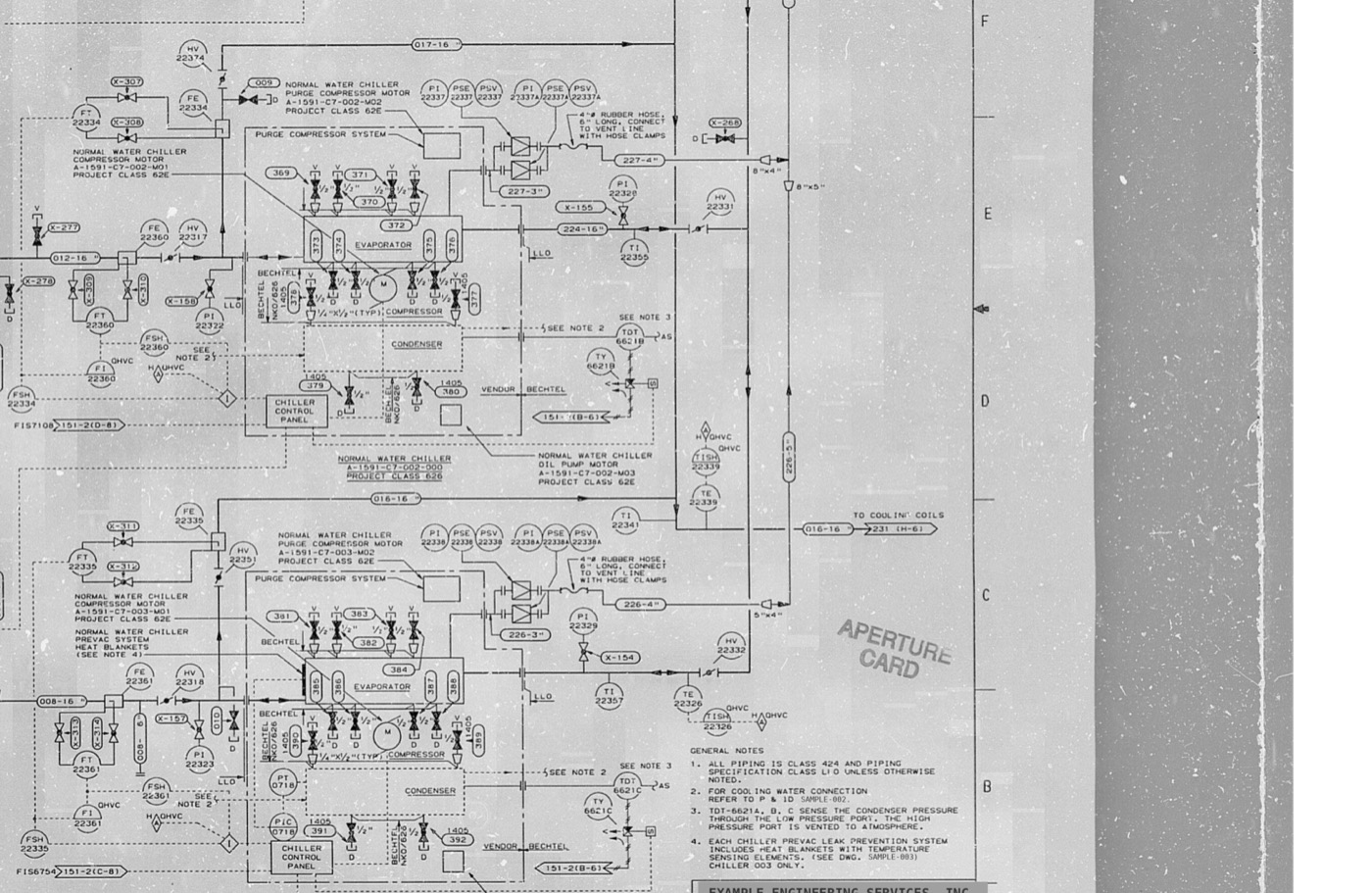
From a review of a chiller plant P&I diagram: the actual sheet, its operating-mode valve table, and what Vault made of them.

1 Read

It reads the sheet like a reviewer, not a scanner.

Identity, plot stamp, levels served, tagged elements, test boundaries. Vault extracts the facts a human looks for first, and shows its work for each one.

2 Verify

Every revision is verified against the chain.

The sheet title is matched to its register row and REV 19 is confirmed current, not assumed. Then the cross-references are walked item by item: the operating-mode valve table resolves nine valve tags across seven modes, and the condenser-water positions are matched on companion sheet SAMPLE-002. All of them, automatically.

3 Link

The sheet becomes a door into the evidence.

Pick a pump on the diagram and Vault opens its record: its duty and motor with lineage to the equipment spec, its grid location on the sheet, test status from the tag register, and the 72 documents linked to the same unit.

4 Ask

Then you just ask the drawing.

Questions that used to mean an afternoon of cross-walking come back in seconds, with the answer and its sources side by side. The reviewer confirms; Vault fetches.

CHW flow diagram
Drawing factsSHEET 1 OF 1 IN REVIEW
IdentityP&I Diagram · Normal ChillersSystem No. 1591 · SAMPLE-001READ
MetadataREV 19 · SCALE NONE · E-SIZEissued for constructionREAD
Systems3 chiller trains · 3 CHW pumps · expansion tankREAD
Elements480 foundvalves · instrument bubbles · motors · control panelsTAGGED
Pipe specsCLASS 424 · SPEC L/Ofrom general notes, applied to every lineREAD
Holdsnote 4 heat blankets · valve table governs 7 modesREAD
Additional valves mark-up
Revision checkAGAINST REGISTER
verified
Chain verified. SAMPLE-001 REV 19 matches its register row · current issue confirmed.
flag
Cross-reference resolved. Operating-mode table → 9 valve tags across modes A to G. Condenser-water positions matched on companion sheet SAMPLE-002, item by item.
PUMP P7-001 · equipment viewLIVE
Duty · normal chilled water motor P7-001-M01 · project class 62EEQUIPMENT SPEC · 4 CITED DOCS
Location · grid F-6 · SAMPLE-001 read from sheet coordinatesDRAWING METADATA
Test status from the tag registerL1L2L3
Serves · chiller 001 evaporator loop with isolation valve X-270 on the branchLINKED DOCUMENTS
PUMP P7-003 · same header 72 documents linked to this unitDOCUMENT INDEX
Ask the drawingANSWERED IN 4S
which valves have to be open in operating mode B?
Mode B holds four valves open per the operating-mode table, with chiller 003 lead and 001 standby. Each valve tag links to its register entry, and the matching condenser-water positions come from companion sheet SAMPLE-002.
SAMPLE-001 · Valve TableSAMPLE-002 · Condenser Water
What the sheet knows

One read, a whole graph of facts.

A drawing is not a picture; it is a database wearing a picture. Vault extracts it as one, and every fact becomes a node your project graph can answer from.

badge

Sheet metadata

Drawing number, revision, scale, status. SAMPLE-001 · REV 19 · SCALE NONE · E-size sheet.

location_on

Equipment & location

Every tag with its grid reference. PUMP P7-001 lives at grid F-6 and links straight to its record.

valve

Pipe sizes & services

Class 424 piping, spec L/O, line sizes read from the sheet and traced service by service.

speed

Instruments & points

PI, TI and FSH bubbles matched to their points, so the sheet and the points list agree.

flag

Boundaries & holds

Notes, holds and the operating-mode valve table read as first-class objects, not decoration.

verified_user

Code & standards checks

Sheets checked against the codes and standards you nominate: building code clauses, ASHRAE guidance, project specs. A deviation is flagged with the clause it trips.

hub

Cross-sheet links

SAMPLE-001 knows about companion sheet SAMPLE-002 and the register row that governs it.

SHEETS EQUIPMENT LINKED EVIDENCE SHOWN AT F-6 COMPANION CROSS-REF DRIVEN BY MEASURED BY GOVERNED BY FACTORY TEST CALIBRATED SAMPLE-001 NORMAL CHILLERS P&ID SAMPLE-002 CONDENSER WATER P&ID PUMP P7-001 GRID F-6 · CLASS 62E · L1 L2 L3 MOTOR P7-001-M01 EQUIPMENT SPEC · 4 DOCS PI 2231 · TI 22376 INSTRUMENT POINTS · VERIFIED VALVE TABLE OPERATING MODES A TO G EOL-26-01447 FACTORY TEST OK CAL CERT 20517 TI 22376 · ISO 17025 + 65 MORE LINKED DOCUMENTS
Same sheet, two reads

Drag to see what Vault adds to the sheet.

Left is the sheet as issued. Right is Vault’s pass: every vessel, pump and chiller train, the control panels, the valve table, line sizes and reducers, all tagged where they sit, with holds flagged for the reviewer.

Vault annotated drawing
EXPANSION TANK · T7-001
CHEMICAL FEED POT
CHW PUMPS · P7-001/002/003
CONE STRAINER · AIR SEPARATOR
15X12 REDUCER
CHILLER 001 · EVAP / COND / PURGE
CHILLER 002 · EVAP / COND / PURGE
CHILLER 003 · EVAP / COND / PURGE
NOTE 4 · HEAT BLANKETS
VALVE TABLE · MODES A TO G
SEQUENCE CONTROL PANEL
LINE 228-4 · 8 IN
GENERAL NOTES · CLASS 424
TITLE BLOCK · REV 19
Raw drawing as issued
drag_indicator
AS ISSUED VAULT READ
Why it pays

The industry numbers behind document risk.

These are published figures, not ours. They describe what escaped document errors already cost on projects like yours.

10 to 25%

of project cost is lost to avoidable error in construction, around 21% once indirect costs and latent defects are counted.

GIRI · UK Get It Right Initiative
$1,080

average cost to review and respond to a single RFI, from a study of over one million RFIs on 1,300 projects. Typical response takes ~10 days.

Navigant Construction Forum
30 to 50%

of RFIs stem from errors, omissions or ambiguities in the construction documents themselves.

Construction Industry Institute
~70%

of rework can be traced back to design- and engineering-related error, per the published rework literature.

LOVE ET AL. · REWORK STUDIES

What that means on one project.

A worked example: a $50M data center package with a 500-sheet mechanical and controls set, reviewer cost at $95/hour loaded. Assumptions shown so you can swap in your own.

Cost driver
Manual review
With Vault
Review labour 500 sheets · pilot-measured pace
remove~38 min/sheet → 317 h ≈ $30,100
timer~6 min guided → 50 h ≈ $4,750
Cross-reference coverage
removesampled under deadline
done_allall of them, every sheet
Document-driven RFIs ~500 RFIs on $50M · 30 to 50% document-driven · $1,080 each
remove$162k to $270k exposure downstream
flagflagged at review, before they become RFIs
Review trail
removenotes in the margin
format_quoteevery fact cited to its source

Review pace figures are from ODUM AI pilot sessions. Industry figures: GIRI research reports on the cost of avoidable error; Navigant Construction Forum, “Impact & Control of RFIs on Construction Projects” ($1,080 per RFI, ~9.9 RFIs per $1M of construction); Construction Industry Institute estimates cited therein; P.E.D. Love et al., rework cost literature. RFI counts scale with project value; swap in your own rates and volumes.

Beyond the drawing

One reader for the whole evidence trail.

Drawings are one of 30+ document types Vault reads on a commissioning project. The same pass that reads a flow diagram also reads the paperwork that has to agree with it, so the whole package answers as one.

P&I diagramsDRAWING
Detail sheetsDRAWING
Points listsBMS
Graphics screenshotsBMS
Calibration certificatesCERT
End-of-line reportsREPORT
Alarm capturesBMS
Field photosFIELD
Vault vs a general model

Why not just paste the sheet into a chatbot?

Vault uses frontier models inside its pipeline. The difference is everything built around them: full-resolution sheet handling, your project records, and a rule that no fact enters the record without a source.

Capability
General LLM chat
CxSTAT Vault
Reading the sheet
removea compressed screenshot in a context window
grid_onfull-resolution pipeline built for E-size sheets, every element tagged
Your project records
removehas never seen your register or tag schedule
rulereconciles every fact against your register, tag schedule and points list
Citations
removeoptional, sometimes invented
format_quotemandatory: a fact without a source never enters the record
Domain model
removegeneric construction knowledge
schemabuilt on the Turii ontology: levels, tags, boundaries, evidence types
Consistency at scale
removeanswers drift from sheet to sheet
done_allone schema from sheet 1 to sheet 400, into one project graph
Your data
removemay be retained under consumer terms
lockstays in your project workspace, never used to train models
Questions we get

Frequently asked.

Does CxSTAT Vault work on messy, scanned or hand-marked drawings?add
Yes, that is the point. The screens on this page are from a real pilot: original-format PDFs, hand mark-ups and BMS screenshots, not clean test files. CxSTAT Vault reads original documents as they are, because that is what real commissioning packages look like.
What happens when CxSTAT Vault is not sure about something?add
It says so. Extractions carry confidence, and anything below threshold is queued for a human decision rather than silently accepted. A fact only enters the record with its source attached, so an uncertain read is visible, never buried.
Does this replace our commissioning authority or reviewer?add
No. CxSTAT Vault prepares the review: it reads, reconciles and links the evidence. Severity, acceptance and sign-off remain human decisions, made faster because every question already has its documents open.
Where does the reviewed data go?add
Into your project's evidence graph inside CxSTAT IQ. Equipment, tests, issues and documents stay linked, so the same facts power readiness views, risk analytics and CxBrain answers, with lineage back to the sheet they came from.
Is our data used to train AI models?add
No. Your documents are processed inside your own project workspace and are never used to train ODUM AI models or any third-party foundation model. Where external model providers are part of the pipeline, they run under enterprise terms with zero data retention and no training on your content.
Where is our data stored and how is it secured?add
In the EU (europe-west1), encrypted in transit and at rest. Source documents sit in private storage with project-scoped access, extracted facts live in your project's evidence graph, and both can be exported or deleted on request. Access is limited to your project team.
Why not just ask a general chatbot like ChatGPT or Claude?add
General models are strong at language and weak at your project records. They read a compressed screenshot, they have never seen your drawing register, and they will answer with or without evidence. CxSTAT Vault uses the same class of models inside a pipeline that feeds them full-resolution sheets, cross-checks every output against your register and tag schedule, and refuses any fact that cannot cite its source.

Drawings and documents shown are anonymised samples for demonstration. Calibration certificate photo: Wikimedia Commons, CC BY-SA 4.0.